
The savings opportunity is already in your notes. A custom fastener could be simplified. Similar part numbers may be worth consolidating. An assembly step keeps creating extra work. As your team builds its 2027 plan, the challenge is deciding which opportunity to move forward and what it will take to make the improvement happen.
A fastener savings plan connects an opportunity to an agreed baseline, application requirements, implementation costs, responsible people, and a way to check actual results. Start with two or three opportunities your team can evaluate well, then give each one a clear next decision.
Start with a baseline everyone can use
Choose a part family, assembly, or recurring issue and define the period you are reviewing. Record actual usage, current unit cost, and the delivered-cost assumptions behind it. Add documented processing, outside services, or assembly expenses when they are relevant. Purchasing records, inventory history, quality reports, and observations from the line can help establish what happens today.
Use the same volume and scope when comparing options. Otherwise, a production slowdown could look like a sourcing improvement, or a volume increase could hide one. Record what is included so purchasing, operations, and finance can follow the comparison. Our article on fastener total cost of ownership explains the costs surrounding the purchase price.
Choose opportunities that can move forward
Consider the potential benefit alongside the effort and uncertainty involved. A lower-cost alternative that requires extensive validation may need a different timeline from a purchasing-process improvement. Ask whether the necessary data is available, who needs to participate, and what could prevent the change from reaching production.
A practical starting point might be one costly custom part, one group of similar items, or one recurring assembly problem. Field's Value-Added Engineering services include print reviews, product teardowns, and part-consolidation evaluations. The right approach depends on the application and the question your team needs to answer.
Put an owner and a decision behind each idea
For each opportunity, name the person coordinating the work, the people supplying information, and the authorities who approve the change. Give the next decision a target date: obtain samples, agree on a test plan, review results, or authorize a pilot. A date for a specific decision is easier to manage than a general instruction to find savings.
Include the practical transition. Existing inventory, tooling, work instructions, replenishment settings, and supplier lead times may all affect when a change can begin. Identify testing and implementation costs before presenting the estimate. Engineering and quality retain approval under your procedures, including any required customer approvals.
Keep the savings stage visible
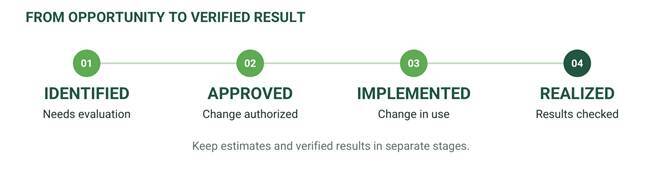
Identified means a potential improvement needs evaluation. Approved means the required reviewers have authorized the change. Implemented means the change is in use. Realized means actual results have been checked against the agreed baseline. Keep these stages separate so an attractive estimate does not become a reported result before the work is done.
In Field's published Engineering Integration Success example, a special fastener's thread problem led to testing standard alternatives. Following approval, a Field engineer processed the Engineering Change Request. It is a useful illustration of the follow-through needed to move a recommendation forward.
Show the estimate, then check the result
Consider a hypothetical part used at 100,000 units annually. Assume the current unit cost is $0.12 and an approved alternative costs $0.10. At that volume, the annualized piece-price opportunity is $2,000. If testing and transition cost $600 once, the first 12 months after full implementation would produce an estimated $1,400 net benefit, assuming the volume and prices hold and no other costs change.
A July implementation would contribute less to that calendar year's results than a January implementation. For any reporting period, use actual units purchased or consumed under the agreed method, apply the unit-cost difference, and subtract the relevant implementation costs. Recheck the estimate if demand, pricing, or scope changes.
Keep other benefits visible without folding them into the same savings number. Hours returned create capacity; count hard expense savings when an expense is removed. Inventory reductions may release cash, which is separate from recurring expense savings. This gives leaders a useful view of both operational value and financial results.
Give the first 90 days a realistic sequence
During the first 30 days after kickoff, confirm the baseline, requirements, owners, and missing information. By the next review, aim to assess alternatives, obtain samples where appropriate, and agree on the evaluation plan. Use the following period for a pilot and early measurement if approvals and lead times allow.
Those are planning milestones, not a promise to finish every change in 90 days. Some applications need longer validation or customer approval. Record the next decision and the reason for any delay so the opportunity stays visible. If December is too crowded, schedule a January kickoff with the people needed to move it forward.
Bring one opportunity to the conversation
You do not need to review the entire bill of materials at once. Bring Field a part, part family, or recurring issue and describe what your team wants to improve. We can help determine what information is needed and which evaluation makes sense. Talk with Field about your next fastener improvement and give the opportunity a practical next step.